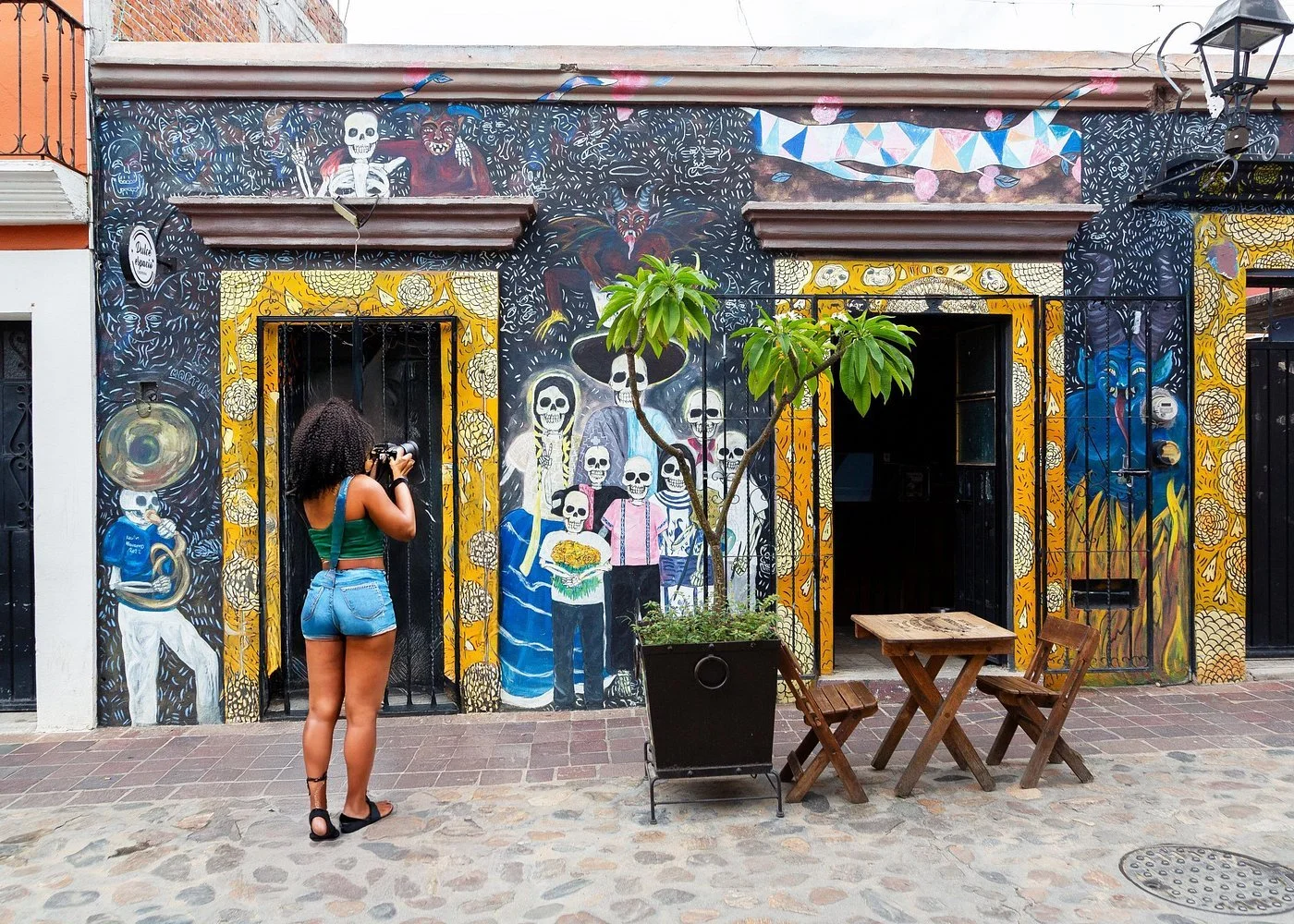
“Muertos y aparecidos”, a Oaxaca City walking tour ideal for Day of the Dead, from author Daniel Brena.
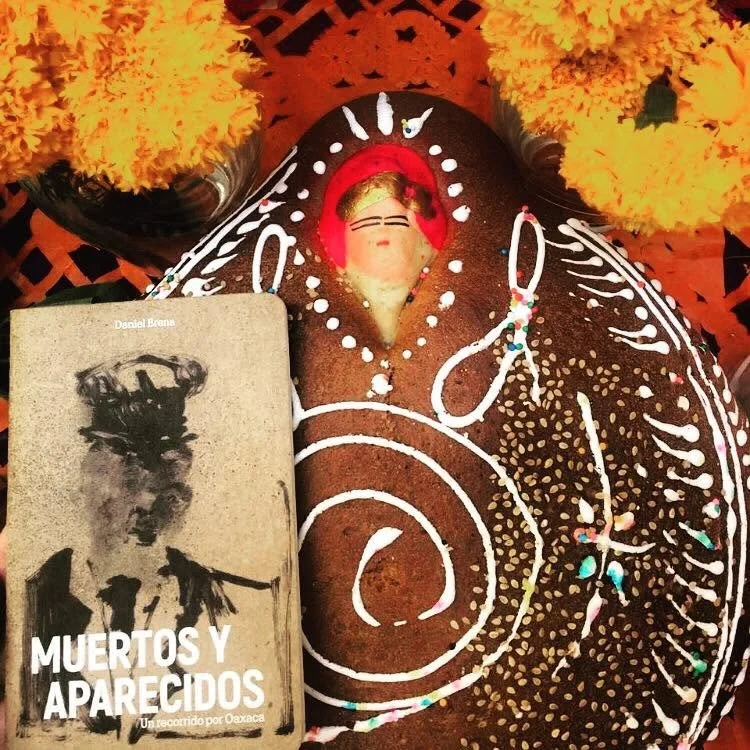
The mini guide, “Muertos y Aparecidos” by Daniel Brena published on 2018 in Oaxaca en tu bolsillo series.
Photo: Muertos y aparecidos from Facebook profile.
All rights reserved to the author and the editorial house.
In 2018, under the editorial house Oaxaca en tu bolsillo, author Daniel Brena released a captivating series of curated walking tours through the heart of Oaxaca. Among these unique itineraries, readers could discover an artistic pilgrimage exploring the city's iconic works and installations by Francisco Toledo, a specialized route tailored for photographers, and an enchanting guide woven with haunting local legends. Appropriately titled Muertos y Aparecidos (The Dead and the Apparitions), this guide unveils the most terrifying and secretive corners of Oaxaca. Complete with detailed maps to navigate its spine-chilling routes, it immerses travelers in the rich oral tradition, myths, and folklore of Oaxaca—stories that remain, to this very day, far more alive than dead.
Below are the key stops and eerie tales from the Muertos y Aparecidos guide, allowing you to embark on a self-guided journey through Oaxaca’s darkest legends—if you dare to brave a scare along the way.
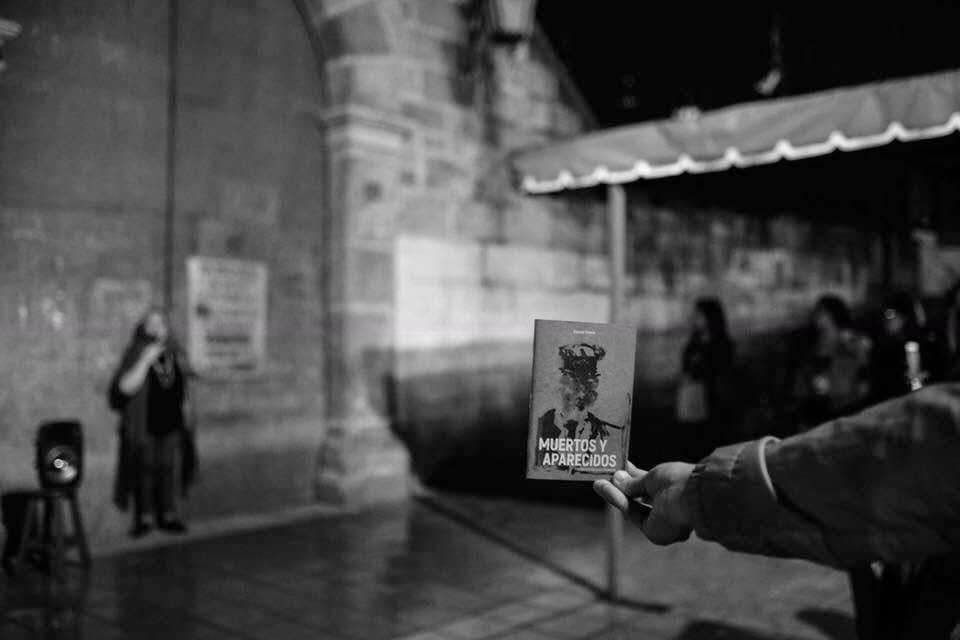
Muertos y Aparecidos Mini Guide, touring the Oaxaca City streets.
Photo: Muertos y Aparecidos Facebook profile.
1. Zocalo of the city: The death of Juan Estrella. (XIX Century)
That night, the house staff frantically set out to find a doctor. Juan Estrella was severely ill, coughing up blood.
Juan Estrella had just fought with his son, Andrés, who left the house in a fit of rage. Before departing, Andrés approached the cook as she was making mole almendrado for dinner, sending her on a quick errand so he could finish grinding the almonds.
Estrella died the next morning. Later, the cook uncovered a crumpled paper pouch with remnants of powdered glass—which Andrés had secretly mixed into his father's dinner.
Note: Where now is the Pakar Shoes store in Las Flores Arc is where this story happen.
2. The hands of Christ.
Every morning, Agustín Olmedo walked beneath the arches of the Portal de las Flores on his way to his textile shop. And every morning, halfway through his journey, he paused to kiss the hands of a statue depicting Christ bound to a column. Yet on that fateful day, as Olmedo leaned in to touch his lips to the image, Christ’s hands miraculously pulled back.
Unbeknownst to Olmedo, the sacred statue had just saved his life. One of his bitter enemies, Pedro Berruguete, had plotted his murder by coating the hands of the Christ figure with deadly poison.
Justice, however, found the villain instead: Berruguete met his own demise when his servant inadvertently served him water in the very same cup used to store the venom
Note: The statue is no anymore there, it was in the central column of the Flores Arcs.
3 . The Couplet Street
The first time the barber spoke to the baker’s wife, he wooed her in verse:
“Morir será una suerte / pero contigo / si como tú es la muerte / cargue conmigo.”
(“To die would be a blessed fate / if I were near to thee / for if death wears a face like thine / then let it carry me.”)
They began meeting in the dead of night while the baker kneaded dough in his workshop. It was not long, however, before the baker uncovered the betrayal. Seeking revenge, he devised a cunning plan. Day by day, he began hiding various bakery supplies—flour and sugar, among others—and then alerted his workers that a thief was stealing from them.
One early morning, as the workers were already baking bread, they heard someone forcing the door open. Catching the barber in the dark and believing him to be the thief, the men beat him with such brutality that even the baker, overcome with pity, finally let him escape.
Note: This street was know as the Couplet street.
4 . The lady’s phantom (1930)
At half-past eleven at night, Vicki Solana hailed a taxi outside the Panteón Jardín cemetery. She asked the driver to take her to various churches throughout the city, explaining that she had a solemn vow to fulfill. Two hours later, her nocturnal pilgrimage came to an end at the Iglesia de la Soledad, after which they returned to the cemetery gates.
Having no money on her, she convinced the cab driver to collect the fare from her father. As a pledge of good faith, she handed him the ring from her finger. The following morning, when the driver presented the ring to the woman’s father, the old man recognized it instantly: it was his daughter’s wedding ring. Bewildered and shaken, he could not comprehend how this was possible—his daughter had passed away several years ago.
This story takes place in the house, which was covered while undergoing repairs.
5 . Division de Oriente Street
When Martín, the son of Hernán Cortés, plotted to declare independence from Spanish rule, he did not conspire alone. Joining forces with the De Ávila brothers, they crafted an ambitious scheme that was destined to fail: the brothers were ultimately beheaded after the Viscount of Ledesma betrayed their plan to the Royal Crown.
Seeking retribution, a third De Ávila brother journeyed from Spain to Oaxaca. He lured the Viscount to Martín’s former estate, capturing him upon arrival and forcing him into a cramped cellar, where he bound him to the wall with heavy chains. He then walled up the entrance, entombing his enemy alive. Decades later, when the mansion was finally demolished, the Viscount's skeleton was discovered within the forgotten room.
6 . El Callejón del Muerto (The Dead Man's Alley) also called El Calvario street.
“A man has been stabbed. He needs his last rites,” whispered the stranger to Padre Montes.
The priest followed the mystery man into a dark, narrow alley, where the wounded victim lay motionless on the ground. Leaving behind his companion, who carried a lantern, Padre Montes knelt beside the dying man.
The man gasped his final breath as soon as his confession was complete. When Padre Montes turned back to find the guide who had led him there, he discovered only the abandoned lantern resting on the cobblestones. Lifting the light to illuminate the dead man's face, horror struck the priest: the deceased bore the exact features of the stranger who had brought him to the alley.
Terrified, Padre Montes fled back to his parish, paralyzed by the realization that he had taken the confession of a ghost. In the days that followed, a severe fever took hold of him; when he finally recovered, he noticed he had been left permanently deaf in the very ear that had heard the dead man's sins.
You can watch an animated short of this story in Spanish here
7 . The Wheelbarrow of Death
Since 1790—and to this very day—a phantom wheelbarrow draped in black, dragged by two towering oxen, emerges at the stroke of midnight. Whenever it appears, locals know with grim certainty that someone will meet their death the following day.
You can watch an animated short of this story in Spanish here
8 . The Mad Nun (XVIII Century)
A tragic misunderstanding led Sofía to believe that Luis had betrayed her, driving her to seek refuge within the Capuchin Convent. Heartbroken, Sofía descended into madness, spending her days sitting by the edge of the fountain, plucking petals from flowers. For years to come, Luis wandered near the convent and spent endless hours inside the Church of San José, finding solace in the mere feeling of being close to her. One morning, his body was found lifeless near the choir loft. That very same day, Sofía passed away as well.
9 . The Legend of Our Lady of Solitude (1620)
In 1620, a group of muleteers journeying from Veracruz to Guatemala noticed an extra mule following their caravan. They searched everywhere for its owner, but found no trace of anyone. Upon arriving in the city of Oaxaca to rest, the stray mule—carrying a heavy wooden crate strapped to its back—collapsed atop a large stone.
Hours passed, and seeing that the creature could not rise, the muleteers attempted to ease its burden by removing the crate from its back. The moment the weight was lifted, the mule stood up, shook itself, and suddenly collapsed to the ground, dead. Upon opening the crate, they discovered the carved hands and face of a statue of the Virgin Mary, accompanied by an inscription: 'Our Lady of Solitude at the Foot of the Cross.' To this day, the very stone where the mule collapsed can still be seen to the right of the basilica's entrance.
10 . The Lord of Redemption
In Oaxaca, those who wish to gaze upon the true likeness of Christ need only visit the Basilica of Nuestra Señora de la Soledad. Tucked away at the back on the right-hand side stands a statue clad in a purple robe, crafted precisely according to the vision described by Sister Antonia de la Madre de Dios to the sculptor Amador Ramírez.
How did she know the features of Christ’s face so intimately? Sister Antonia was the only nun in the convent to whom Christ appeared in frequent visions. Perhaps He revealed Himself solely to her because of her extraordinary devotion to prayer, regardless of her circumstances. Even when stricken by illness, she always found a way to pray, refusing to miss Mass even while bedridden and recovering.
Other amazing stories to explore on Day of the Dead…